
Industrial pipework rarely fails because one pipe is slightly out of place. Problems usually build when several small inaccuracies meet in a busy plant room, factory service area or cooling space. A run that looked simple on paper can suddenly need to work around steelwork, valves, pumps, access routes, existing services and future maintenance needs.
That is where pipework fabrication earns its place. By preparing sections, joints, brackets, valves and manifolds with care before final installation, contractors can make industrial pipework fit more cleanly, safely and predictably on site.
What pipework fabrication means in industrial installs
Pipework fabrication is the planned preparation of pipe sections and associated components before they are installed as part of a working system. It can include cutting pipe to measured lengths, preparing ends, welding sections, forming bends, assembling valve sets, building manifolds and checking that components are ready for the conditions they will face.
In an industrial setting, fabrication is not just about making pipe. It is about making pipework that fits the wider installation. A fabricated section may need to connect to a pump, heat exchanger, vessel, pressurised line, cooling circuit or plant room distribution header. Each connection point matters because a small mismatch can affect alignment, support, access and commissioning.
Good fabrication starts with understanding the route. Contractors look at drawings, survey information, equipment positions, isolation points and maintenance requirements. The aim is to turn a design into sections that can be moved, lifted, connected and tested without unnecessary adjustment once the site work begins.
For DSJ Pipework, this sits naturally alongside industrial and commercial pipework work involving welded sections, press fit joints, heating lines, cooling pipework and plant room installations. The value is practical. The more accurately sections are prepared, the more controlled the final installation becomes.
Why accuracy matters before pipework reaches site

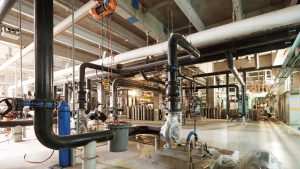
Industrial sites often have limited space and many competing services. Pipework may need to pass above access routes, around existing equipment, through service zones or into tight plant room corners. Once the system is being installed, there may be other trades working nearby and shutdown windows may be carefully managed.
Accurate fabrication helps reduce uncertainty. If the pipe lengths, joint positions and valve orientations have been thought through in advance, the installation team can focus on positioning, fixing, connecting and testing. That does not remove the need for site judgement, but it does reduce avoidable cutting, grinding and adjustment during the install.
Accuracy also matters for system performance. Pipework needs to remain properly aligned so that pumps, valves and equipment are not placed under avoidable strain. Supports need to carry loads correctly. Flanges, unions and joints need to meet cleanly. Expansion, vibration and access all need to be considered before the pipe is finally secured.
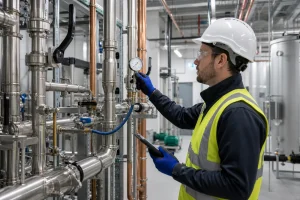
In plant rooms and service areas, accurate fabrication can also make the finished system easier to maintain. Valves should be reachable. Strainers should be removable. Gauges should be readable. Drain points and vents should be placed where engineers can use them. These are not decorative details. They affect how the system will be operated for years after installation.
How prefabricated sections reduce rework risk

Prefabricated sections help by moving a portion of the work into a more controlled preparation stage. Instead of creating every joint, bracket and section in the middle of a busy site, parts of the system can be assembled to suit the installation sequence.
This is especially useful where repeated sections, valve arrangements or manifold connections are needed. If a set of pipe sections can be measured, prepared and checked before arrival, there is less chance of rushed decisions on site. The team can also identify whether components need a specific orientation, support method or access clearance before the work reaches the most pressured stage.
Rework is not always dramatic. Sometimes it is a pipe that needs trimming again, a valve that faces the wrong way, a joint that is too close to a wall or a support that clashes with another service. These issues can slow progress and create unnecessary disruption. Fabrication reduces that risk by encouraging more of those questions to be answered before installation.
It also improves sequencing. Larger systems may need to be installed around equipment deliveries, commissioning dates or planned shutdowns. Fabricated sections can help the work progress in a cleaner order, with fewer loose decisions left for the final fit. For clients, that means the installation is easier to understand and easier to coordinate with other activity on site.
The role of welding, press fit and solvent welded joints

Different pipework systems need different joining methods. Fabrication helps contractors choose and prepare those methods properly rather than treating every joint the same.
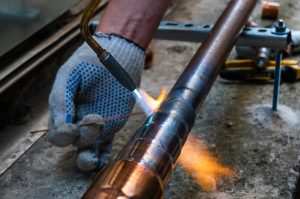
Welded pipework is often used where strength, temperature, pressure or material requirements call for it. TIG and MMA welding can support robust industrial pipework sections when the preparation, fit up and working conditions are right. Readers who want more detail on this type of jointing can explore DSJ Pipework’s TIG and MMA welding for pipework.
Press fit pipework can be valuable where clean, efficient jointing is suitable for the system design. It can reduce the need for hot works in certain contexts and can be useful in commercial and plant room environments when specified correctly. DSJ Pipework also provides press fit pipework installation for appropriate systems.
Solvent welded pipework has its place where compatible plastic pipe systems are used, often for particular process, waste or fluid handling needs. Preparation remains important because clean cuts, correct fitting depth and suitable curing conditions all affect the quality of the joint. More detail is available through DSJ Pipework’s solvent welding service.
The key point is that fabrication is not one method. It is the discipline of selecting, preparing and assembling pipework in a way that suits the system, the site and the final duty.
Valves, manifolds and access are part of the accuracy story

When people think about pipework fabrication, they often picture straight pipe lengths and joints. In real industrial installations, valves and manifolds are just as important. They decide how the system can be isolated, balanced, drained, vented and maintained.
A well planned valve arrangement can make routine work simpler. Isolation valves should be positioned where engineers can safely reach them. Control valves need enough space for operation and future servicing. Strainers, flexible connections and gauges need to be placed with the user in mind, not squeezed into the only gap left at the end.
Manifolds need similar care. Heating and cooling distribution sections often bring several circuits together, which means pipe spacing, labelling, valve access and support all matter. If a manifold is fabricated without thinking about the final plant room layout, the installer may have to make awkward changes on site. If it is prepared with the installation in mind, it can become a tidy, logical part of the system.
This is particularly important in data and technology environments, where cooling pipework must be clear, serviceable and coordinated with the surrounding plant. DSJ Pipework’s experience with data room cooling pipework reflects the same need for accurate routes, reliable joints and careful access planning.
What to look for in pipework fabricators
Choosing pipework fabricators for an industrial installation is not only about whether they can cut and join pipe. The stronger question is whether they understand how fabrication affects the finished site installation.
Good contractors will ask about the system duty, the site conditions, the available space, the shutdown requirements and the access needs. They will think about how sections will be transported, lifted, supported and connected. They will also understand when to fabricate in advance and when final adjustment on site is the better option.
Useful signs include clear communication, practical survey work, familiarity with industrial environments and confidence with more than one joining method. A contractor who understands welded pipework, press fit systems, solvent welding, valves, heating circuits and cooling pipework can make better choices across mixed installations.
Documentation and testing also matter. Fabricated sections should be prepared in a way that supports inspection, pressure testing and commissioning. That includes sensible joint access, visible connection points and a layout that allows engineers to confirm the system is ready before it is placed into service.
Ultimately, fabrication should make the project feel more controlled. It should help the pipework arrive with a purpose, fit with less uncertainty and support a clean industrial installation that can be used and maintained with confidence.
- Pipework fabrication helps industrial installations fit accurately in plant rooms, service areas and cooling spaces.
- Prefabricated sections can reduce rework risk by resolving lengths, joint positions and valve arrangements earlier.
- Welded, press fit and solvent welded pipework each have a place when matched properly to the system duty.
- Valves, manifolds, access and support should be planned as part of the fabrication process, not added as an afterthought.
- The best pipework fabricators understand both preparation and final installation conditions.
Frequently asked questions
What is pipework fabrication?
Pipework fabrication is the preparation of pipe sections and components before installation. It can include cutting, welding, joint preparation, valve assembly, manifold building and checking that sections are ready to fit the intended route.
Is prefabricated pipework suitable for industrial projects?
Yes, when it is planned around the site conditions and system requirements. Prefabricated sections can be especially useful in plant rooms, service areas and installations where accurate positioning and sequencing matter.
Does fabrication replace site fitting?
No. Fabrication supports site fitting by preparing sections in advance, but skilled installation is still needed for final positioning, supports, connections, testing and commissioning.
Which joining method is best for fabricated pipework?
There is no single best method for every project. Welded joints, press fit joints and solvent welded joints all suit different materials, duties and environments. The right choice depends on the system design and site conditions.
Planning an industrial pipework installation?
DSJ Pipework can help with practical guidance on accurate industrial and commercial pipework, from fabricated sections and welded joints to press fit systems, valves, manifolds and cooling pipework.